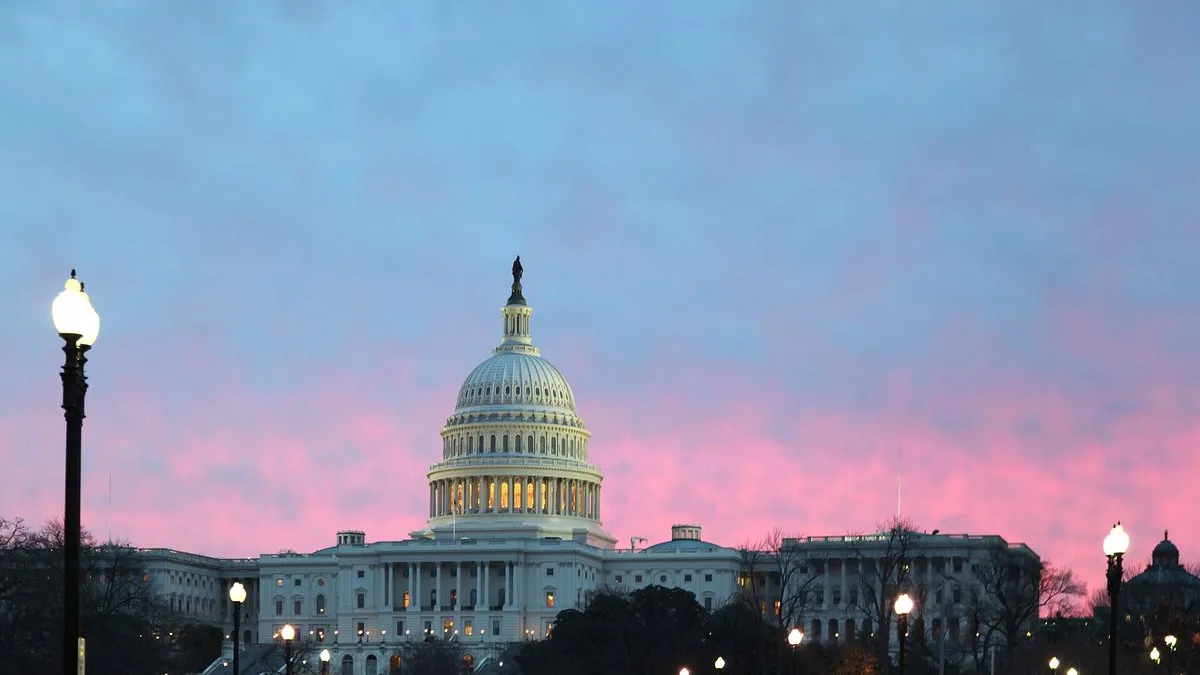
Members of Congress are back at the Capitol after the midterms, and they have roughly a month to keep the government funded. Federal money runs out on December 11. After that date, parts of the government would close unless lawmakers and President Donald Trump agree on a new spending measure.
The politics have shifted. Voters handed Democrats the House and the Senate on November 3, but Republicans keep their majorities until the new Congress is seated in January. That leaves a short period in which the outgoing majority can still pass bills, and in which both parties are deciding who will lead them next year.
What a lame-duck session is
A “lame-duck” session is any meeting of Congress held after an election and before newly elected members take office. Some of the people voting have lost their seats or are retiring, which is where the name comes from.
These sessions used to be much longer. The 20th Amendment, ratified in 1933, moved the start of a new Congress up to January, shortening the gap between Election Day and the swearing-in. The weeks that remain are often used to finish must-pass legislation before the calendar runs out.
The December 11 deadline
Congress did not finish its regular budget work before the fiscal year began on October 1. It passed a temporary measure in September, known as a continuing resolution, that keeps agencies running at set levels through December 11.
According to the Committee for a Responsible Federal Budget, a nonpartisan group that tracks federal spending, the House has passed three of the 12 annual spending bills for fiscal 2027, and the Senate has passed none. With so few completed, a full-year agreement in the next month looks difficult.
Another short-term extension is one possible outcome. An unnamed House Republican told Fox News to expect a stopgap running into February or March. Such a bill would push the final spending decisions into the period when Democrats hold the majority. Fox also reported that some Democrats have discussed using the funding talks as leverage over the war in Iran.
If no measure passes in time, a shutdown would begin. The country’s longest one, which ran 43 days and ended a year ago this month, is covered in our explainer on what closes and who gets paid.
What else is on the list
Lawmakers have named several other priorities, although it is not clear how many can be completed in the time available:
- A farm bill, the package that sets food and agriculture policy and is normally renewed every five years.
- A transportation infrastructure bill, which Republicans hope to pass.
- A bipartisan tax package that supporters would like to finish by the end of the year.
- Health care provisions. STAT reported that any health legislation passed this year would almost certainly need to ride on a funding bill. Republicans also want to confirm several of the president’s nominees to the Department of Health and Human Services.
- The debt ceiling. The Committee for a Responsible Federal Budget says the limit must be raised by mid-2027 to avoid a default. Some lawmakers may try to address it now, while Republicans still control both chambers.
Cost is part of the debate. The budget group estimates that the policies under discussion could add $200 billion or more if they are temporary, and close to $1 trillion if made permanent.
Rep. Nathaniel Moran, a Texas Republican, told Fox News that it will be “difficult to get a whole lot done,” while noting that some bipartisan work is under way.
The leadership races
Both parties are also choosing who will lead them in the next Congress, and those contests could affect how much gets done.
House Republicans, who will move into the minority, were scheduled to take up their leadership election first. Majority Leader Steve Scalise of Louisiana and Judiciary Committee Chairman Jim Jordan of Ohio are both seeking the top job. In the Senate, Majority Leader John Thune of South Dakota is running to be minority leader and had no announced opponent as of Monday.
Democratic leadership elections are expected a week after the Republican votes. House Minority Leader Hakeem Jeffries of New York is expected to become speaker when the new Congress convenes. Fox News reported that several newly elected Democratic senators have not committed to backing Sen. Chuck Schumer of New York as majority leader.
What to watch next
- Whether leaders release the text of a stopgap bill, and how long it would run.
- The results of the House Republican leadership vote.
- Whether any conditions related to Iran are attached to spending legislation.
- Whether the farm bill and the tax package move on their own or are folded into a larger end-of-year measure.