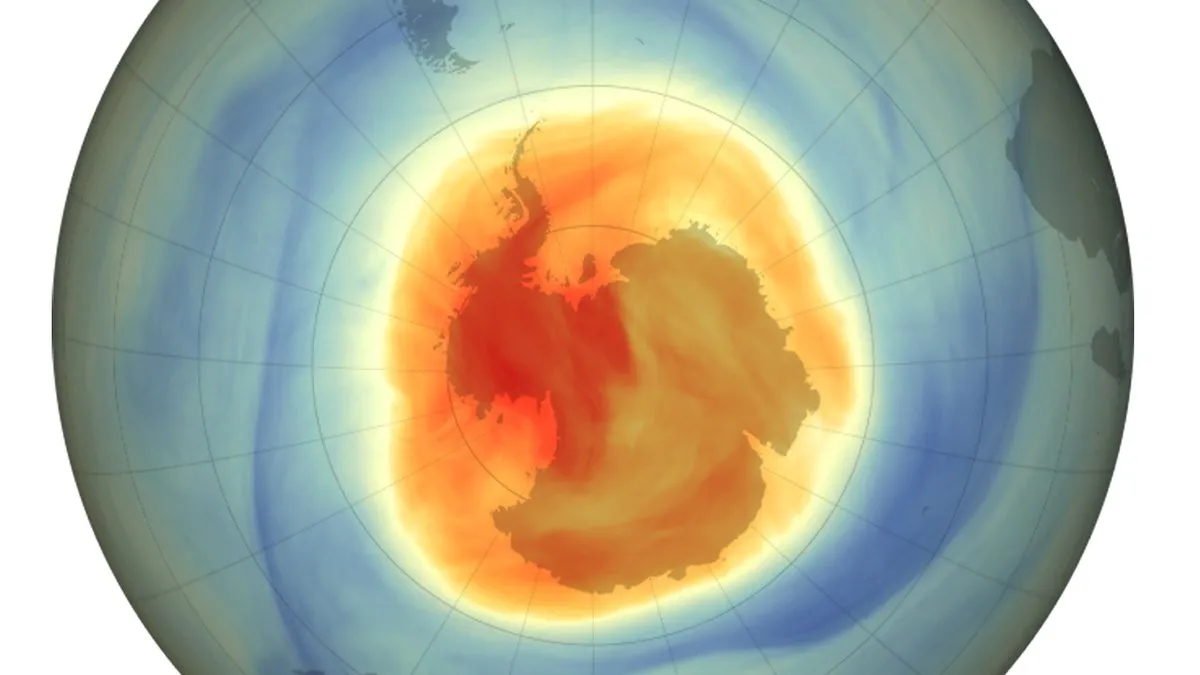
The thinning in the ozone layer above Antarctica grew far larger this year than last, NASA and the National Oceanic and Atmospheric Administration report. Measured over the height of the depletion season, the 2026 ozone hole ranked seventh largest since satellite tracking began in 1979.
On its peak day, September 18, the hole covered 10.5 million square miles, or 27.1 million square kilometers. For scale, the entire United States covers a little under 4 million square miles. NASA says that one-day figure is about 90 percent of the largest hole ever observed.
The result is a clear reversal from 2025, a year the two agencies placed among the five smallest since 1992. Even so, researchers say the jump does not change the long-term picture.
How scientists rank an ozone hole
The word “hole” is a figure of speech. Ozone is present everywhere in the stratosphere, and no part of the sky is empty of it. Scientists use the term for the region where the total amount of ozone falls below 220 Dobson units, a standard measure of how much of the gas sits in a column of air. Before 1979, readings that low had not been observed.
Two numbers describe each year’s hole. Area is how much of the map falls under the threshold, and depth is how low the readings go in the core. The 2026 ranking is based on average area between September 7 and October 13, the most intense part of the season, which came to 9.6 million square miles.
Depth tells a somewhat different story. NASA notes that this year’s hole, while wide, did not reach the low readings seen in several other big years. The deepest on record came in 1994, when readings dropped to 73 Dobson units.
Why it was bigger this year
Antarctic ozone loss follows the seasons. During the dark polar winter, a band of strong winds called the polar vortex circles the continent and traps very cold air inside. When sunlight returns in the Southern Hemisphere’s spring, chemical reactions that destroy ozone speed up in that cold air.
The size of the hole changes from one year to the next, largely because of stratospheric temperature and wind patterns. Colder conditions tend to produce a wider hole with lower readings at the center.
NASA says an unusually strong vortex set up those conditions in 2026. Amy Butler of NOAA’s Chemical Sciences Laboratory told ABC News that large-scale weather patterns, which normally rise through the atmosphere and break the vortex apart, lacked their usual strength during August and September.
How the problem was discovered
The ozone layer absorbs ultraviolet light from the sun. That radiation can damage DNA in plants and animals and is linked to sunburn and skin cancer in people.
In 1985, British Antarctic Survey researchers working at Halley Research Station reported a dramatic seasonal decline in ozone overhead. NASA satellite data then showed that the loss stretched across a continent-sized area.
Researchers traced the damage to chlorofluorocarbons, or CFCs, long-lived chemicals once common in refrigerators and aerosol sprays. CFCs drift for decades near the ground without breaking down. Once they reach the upper atmosphere, ultraviolet light splits them apart and releases chlorine, which can destroy ozone repeatedly. NASA attributes roughly four-fifths of today’s stratospheric chlorine to human activity.
The treaty and the outlook
Concern over CFCs led to the Montreal Protocol, the 1987 international agreement that phased out those chemicals. Because they linger for so long, levels in the atmosphere fall slowly, and large holes can still form in years when the weather favors them.
NASA and NOAA scientists say the controls continue to work, and they still expect the ozone layer to heal later this century. A single large year, they note, reflects weather on top of a slow improvement in the chemistry.
What the numbers do and don’t show
A larger hole this year does not mean that the treaty has failed, and a small hole last year did not mean that the problem was solved. Year-to-year swings are expected, which is why scientists rely on trends across many years.
Ozone loss and climate change are also separate problems, although they are sometimes confused. The ozone hole is caused mainly by chlorine and bromine compounds, not by the carbon dioxide that drives global warming.
NASA began using a new source for this record in 2026, with measurements from the Ozone Mapping and Profiler Suite instrument on the NOAA-20 satellite. Earlier years relied on similar instruments aboard other spacecraft.